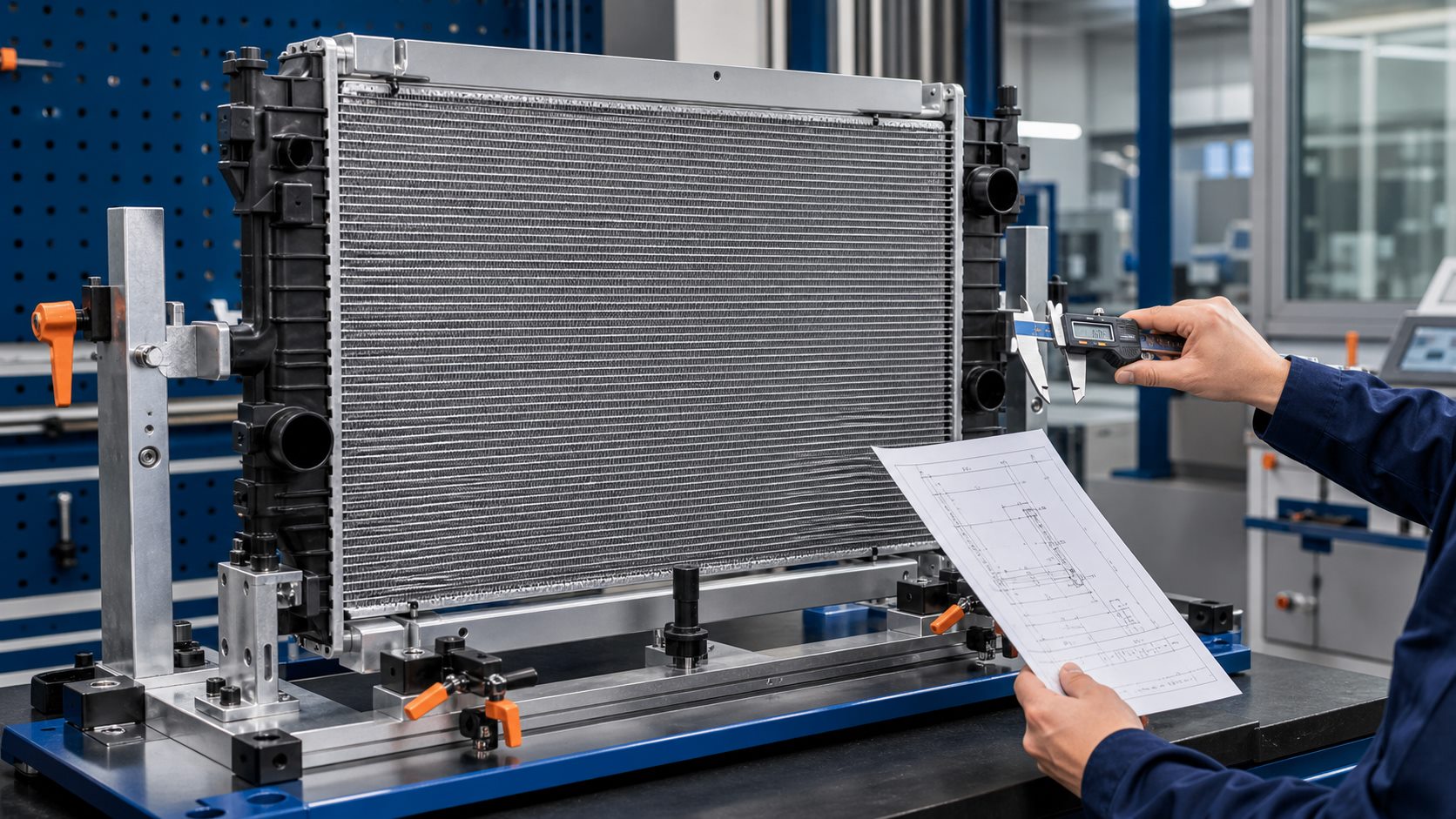
Start with the complete application
Collect the original reference exactly as shown, including its suffix. Add the vehicle generation or chassis, engine code when known, transmission, production date and destination market. Record uncertain information as unresolved rather than filling gaps with assumptions.
If a catalog lists multiple candidates, ask which feature distinguishes them. A cross-reference is a useful lookup aid; it does not establish that every listed variant is interchangeable.
Compare the interfaces that control installation
For radiators, check hose positions, mounting and locating points, fan-shroud interfaces, filler-neck arrangement and any integrated oil-cooler connections. For condensers, compare pipe blocks, brackets, sensor provisions and receiver-drier arrangement where applicable.
Use photos in the same orientation and a marked drawing. Do not approve a candidate simply because its finned core measures the same as the removed part.
Record the agreed variant in the order
Give each confirmed variant a separate line in the RFQ and purchase order. Attach the agreed drawing or sample reference and record the revision. State which features remain open before sample or production approval.
Send UIN your full reference and comparison evidence for a project-specific review. The public catalog helps identify candidates; final specifications and fitment must be confirmed for the particular application.