Start with the complete vehicle application
Record the full OE number, vehicle make and model, chassis or platform, engine, transmission, production period, and destination market. Keep every prefix, suffix, and superseded reference because a single model can use several radiator definitions.
When catalogues disagree, treat the model name as a search clue rather than proof. Use the removed sample, a controlled drawing, or clear photographs to resolve the application before a quotation is approved.
- Complete OE and alternate references
- Engine, transmission and production period
- Destination market and vehicle specification
- Original label or sample photographs
Verify the core and assembly dimensions
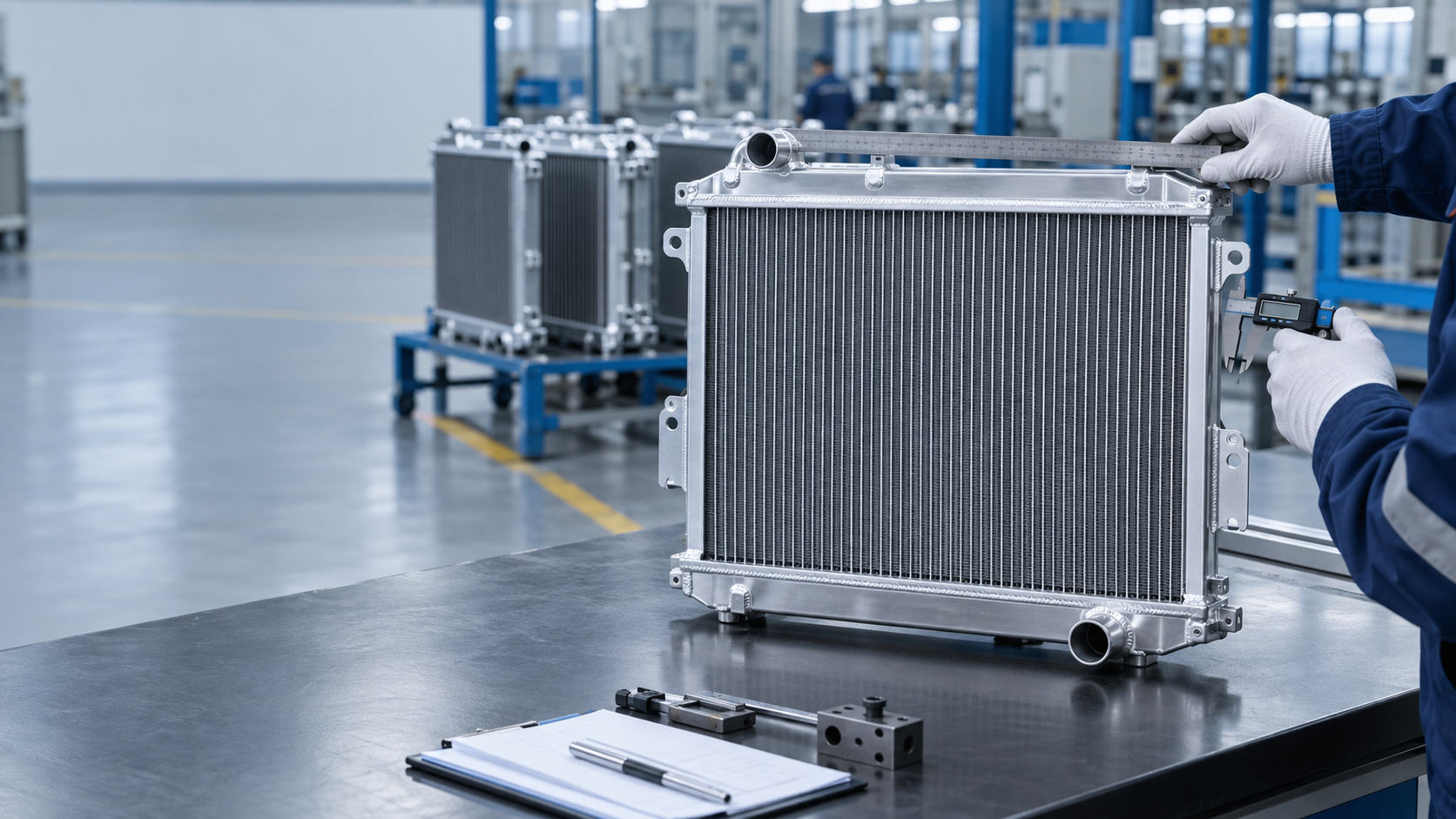
Measure core width, height, and thickness separately from the complete assembly. Confirm total dimensions, tank shape, filler-neck or cap provision, locating pins, brackets, fan-shroud interfaces, drain position, and clearance to nearby parts.
State the measurement method and unit. A drawing or photograph with a scale helps the supplier distinguish finned-core dimensions from overall dimensions and reduces avoidable revisions.
Check every hose and auxiliary connection
Record upper and lower hose diameter, position, angle, vent or sensor connections, and any transmission-fluid or engine-oil cooler. If a cooler is integrated, confirm the fitting type, thread, centre distance, orientation, plugs, and seals.
A small change in outlet rotation or bracket position can create installation stress. Do not assume two radiators are interchangeable because the core appears similar in a catalogue image.
Carry the approved definition into production
Link the approved reference to the drawing or sample, material definition, tooling, assembly, leak test, dimensional inspection, labels, and packaging. Keep a revision record whenever a tank, core, fitting, bracket, supplier, or process changes.
Leak testing confirms containment under defined conditions; it does not by itself prove fitment, heat-transfer performance, coolant flow, cleanliness, or service life. Agree each required control for the specific programme before volume supply.