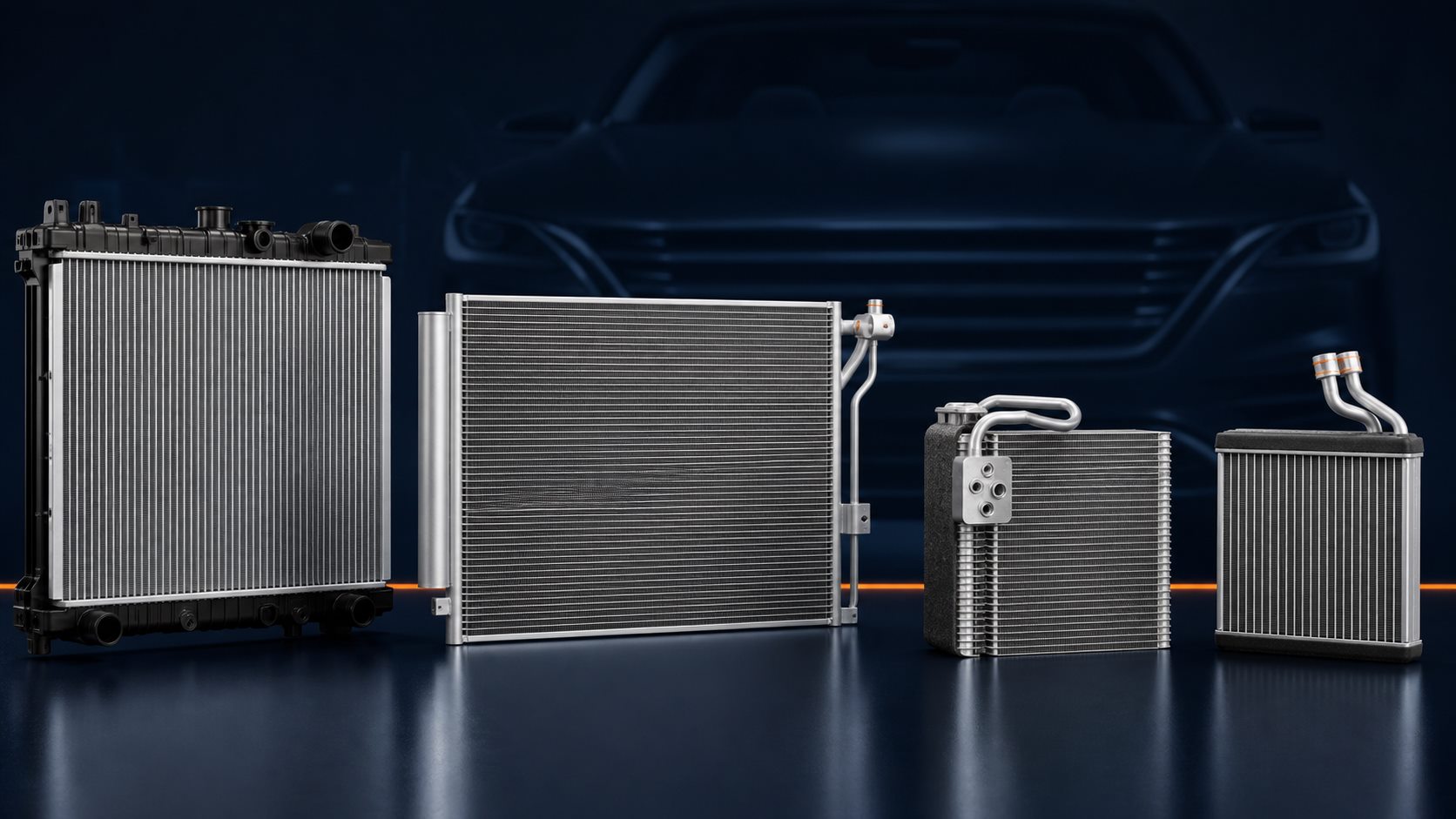
Radiator, Condenser, Evaporator and Heater Core Differences
A radiator cools engine coolant, a condenser rejects heat from high-pressure A/C refrigerant, an evaporator absorbs cabin heat, and a heater core uses engine coolant to warm the cabin. Their circuits, locations and connections are different even when the fin-and-tube construction looks similar.
Radiator: engine-cooling circuit, normally at the front of the vehicle.
Condenser: high-pressure A/C circuit, normally in front of the radiator.
Evaporator: low-pressure A/C circuit, inside the HVAC housing.
Heater core: engine-coolant circuit, inside or beside the HVAC housing.
Radiator, A/C condenser, evaporator and heater-core examples used to compare automotive heat-exchanger functions and identification points.
Quick comparison
Part
Primary job
Working medium
Typical location
Identification priority
Radiator
Reject engine heat
Engine coolant
Front cooling module
Hose, tank, cooler and mounting layout
A/C condenser
Reject refrigerant heat
High-pressure refrigerant
Ahead of radiator
Fittings, drier, sensor and brackets
A/C evaporator
Absorb cabin heat
Low-pressure refrigerant
Inside HVAC case
Connection block, ports and core size
Heater core
Warm cabin air
Engine coolant
Inside or beside HVAC case
Pipe diameter, spacing, angle and drive side
Radiator: engine coolant
The radiator rejects heat from engine coolant and normally uses large hose connections. It may include plastic or aluminum tanks, a filler neck, drain, sensor provision, fan-shroud mounts, or an oil cooler.
Key sourcing details are OE number, vehicle and engine, transmission, core dimensions, tank layout, hose connections, cooler fittings, and mountings.
Condenser: high-pressure refrigerant
The A/C condenser rejects heat from refrigerant after compression and normally sits in front of the radiator. It uses refrigerant fittings and may include a receiver drier or sensor port.
Confirm the production period, dimensions, fitting type, pipe orientation, receiver-drier side, sensor provisions, and brackets.
Evaporator: cabin cooling
The evaporator is inside the HVAC housing, where refrigerant absorbs heat from cabin air. Small differences in connection block, pipe angle, sensor provision, seals, or core size can prevent installation.
Provide the OE number, HVAC application, interface and port spacing, dimensions, brackets, sensor provisions, and removed-part photos.
Heater core: cabin heating
The heater core transfers heat from engine coolant to cabin air and is also installed in or near the HVAC housing. Its coolant pipes must align precisely with the vehicle and housing.
Measure core and overall size separately, then record pipe diameter, spacing, length, angle, brackets, seals, drive side, and vehicle application.