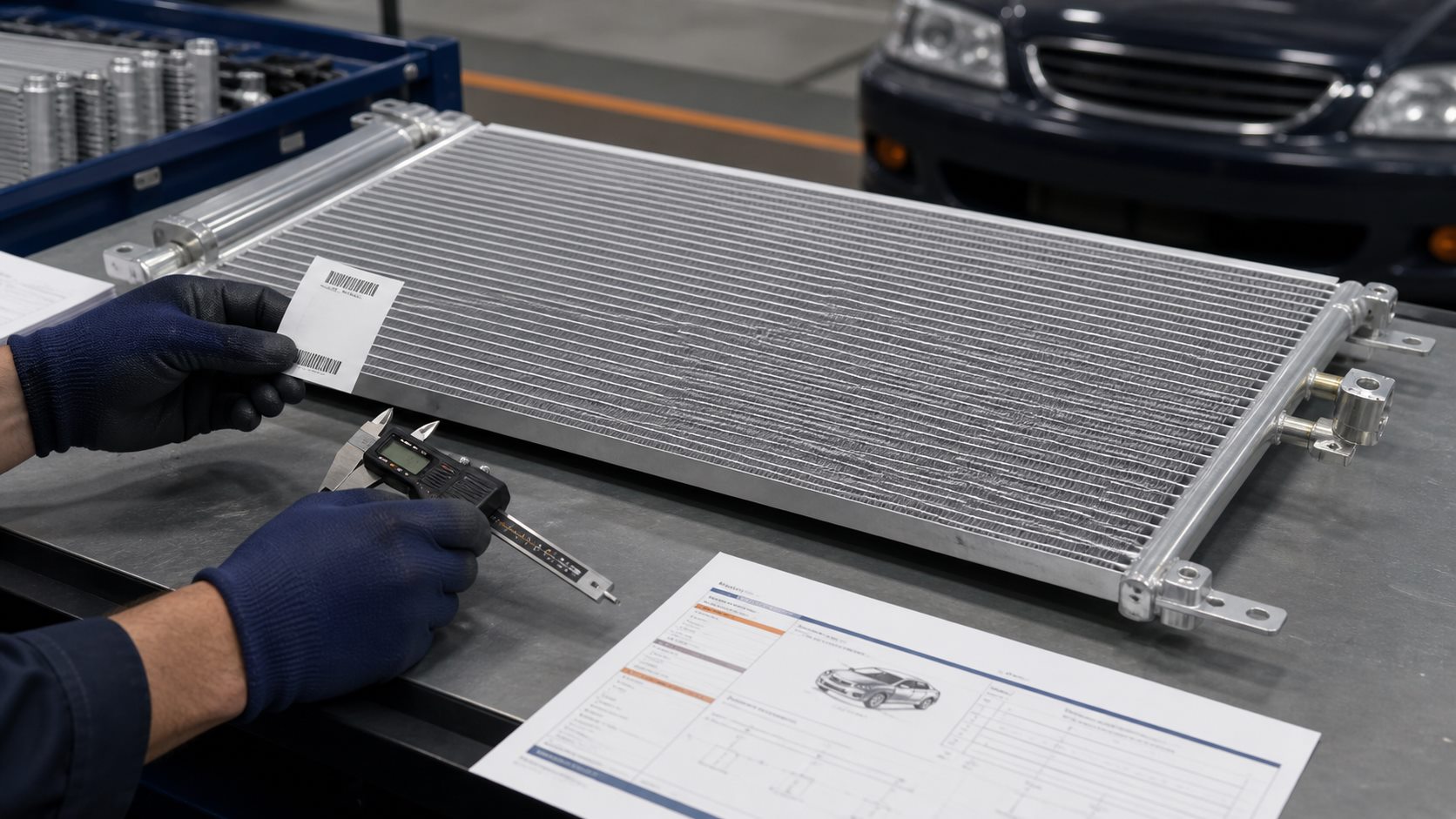
Record the complete reference
Copy the complete number from the original condenser label, vehicle catalog, dealer record, or removed component. Keep leading zeroes, suffixes, spaces, and separators during the first search because a small formatting difference can hide a useful cross-reference.
If several numbers appear, photograph the whole label and record which number came from the vehicle manufacturer, component supplier, or aftermarket catalog. Keep both the searched number and matched alternate reference in the enquiry record.
- Complete OE number
- Alternate or supplier reference
- Clear label photograph
- Source of each reference
Confirm the exact vehicle
A model name can cover several chassis, engines, production periods, and regional specifications. Confirm the make, model, chassis or platform, engine, production month or year, and destination market.
Pay attention to production breaks. A condenser introduced during a model year may differ in core size, receiver-drier position, pipe orientation, or sensor provision even when the model name is unchanged.
Compare the physical construction
Measure the finned core separately from the complete assembly. Compare core width, height and thickness, total mounting span, brackets, inlet and outlet positions, fitting type, pipe angle, receiver-drier side, and sensor ports.
Do not approve a part only because the overall shape looks similar. Small differences around a connection block or mounting tab can prevent installation or stress the refrigerant pipes.
Keep a traceable approval
For an uncertain or new application, use a drawing, dimensional report, detailed photograph set, or physical sample before volume ordering. Keep the approved OE reference, application, drawing revision, and sample status together.
A cross-reference is a strong search key, not a substitute for final technical confirmation.