Start with the complete application
Record the vehicle make, model, chassis or platform, engine, transmission, fuel type, production month or year, and destination market. Keep the complete OE number, including prefixes, suffixes, and superseded references.
If catalog sources disagree, do not select a radiator by model name alone. Use a removed sample, controlled drawing, or detailed vehicle record to resolve the application before approval.
- Complete OE and alternate references
- Vehicle, chassis and engine
- Transmission and cooling package
- Production period and market
Measure the core and complete assembly
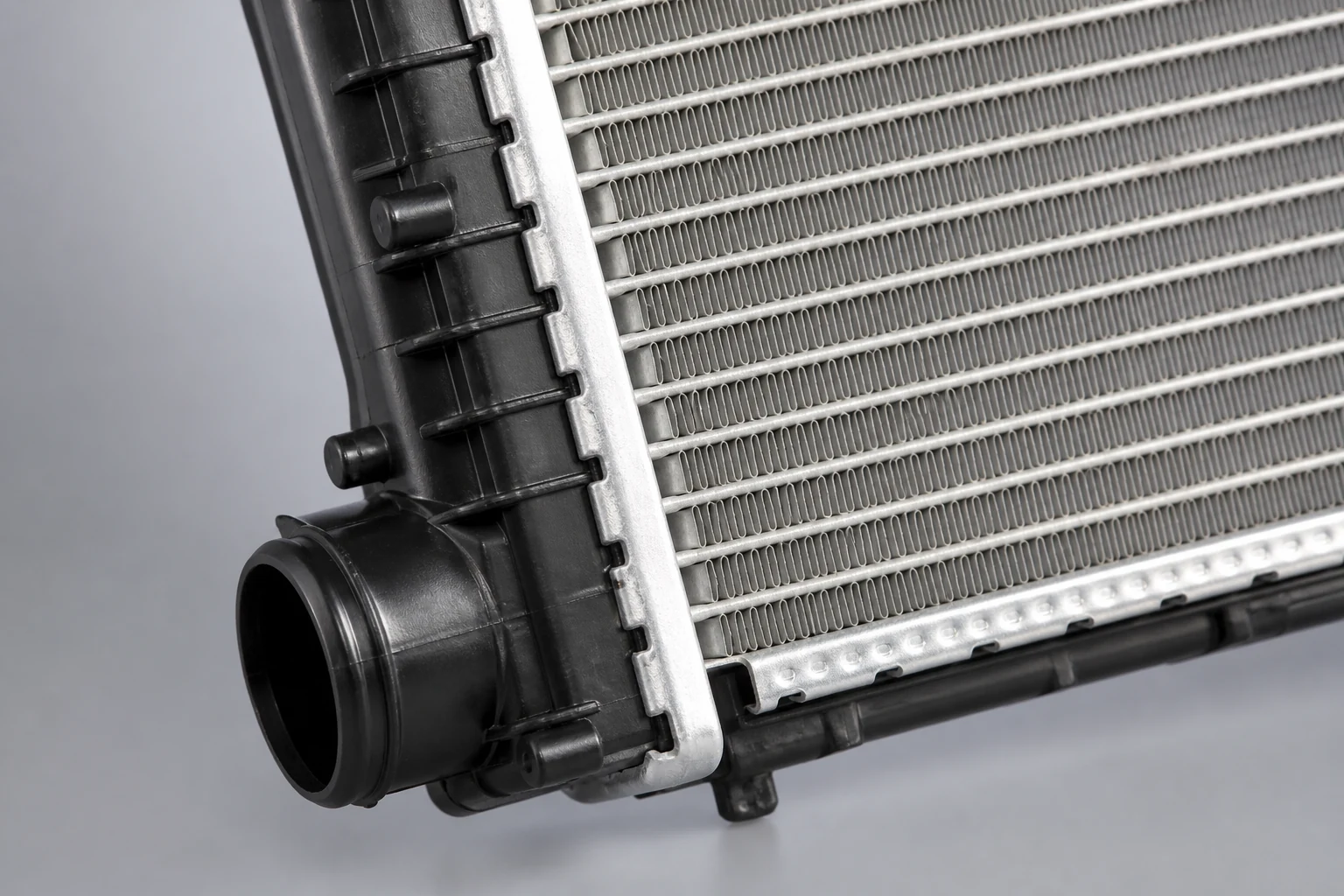
State whether width and height refer to the finned core or the complete radiator. Record core width, height and thickness, total dimensions, locating pins, mounting brackets, filler-neck or cap provision, drain position, and fan-shroud attachment points.
Photographs should show the front, rear, tanks, upper and lower mountings, and each connection. Include a scale or dimensional drawing when the application is not already approved.
Check connections and integrated coolers
Confirm upper and lower hose diameters, position, angle, and any vent, sensor, or auxiliary connections. A hose outlet that is only slightly different can interfere with nearby components or create installation stress.
Where the radiator includes a transmission-fluid or engine-oil cooler, record the cooler type, fitting or thread, center distance, orientation, and required plugs or seals. Do not assume two visually similar coolers are interchangeable.
Carry the approved definition into production
The approved reference should connect the drawing or sample to materials, tooling, assembly, leak testing, dimensional inspection, included accessories, labels, and packaging. Revision control matters whenever a tank, fitting, bracket, core, or supplier changes.
Leak testing confirms containment under defined conditions; it does not by itself prove fitment, heat-transfer performance, coolant flow, cleanliness, or service life. These requirements need their own agreed controls.