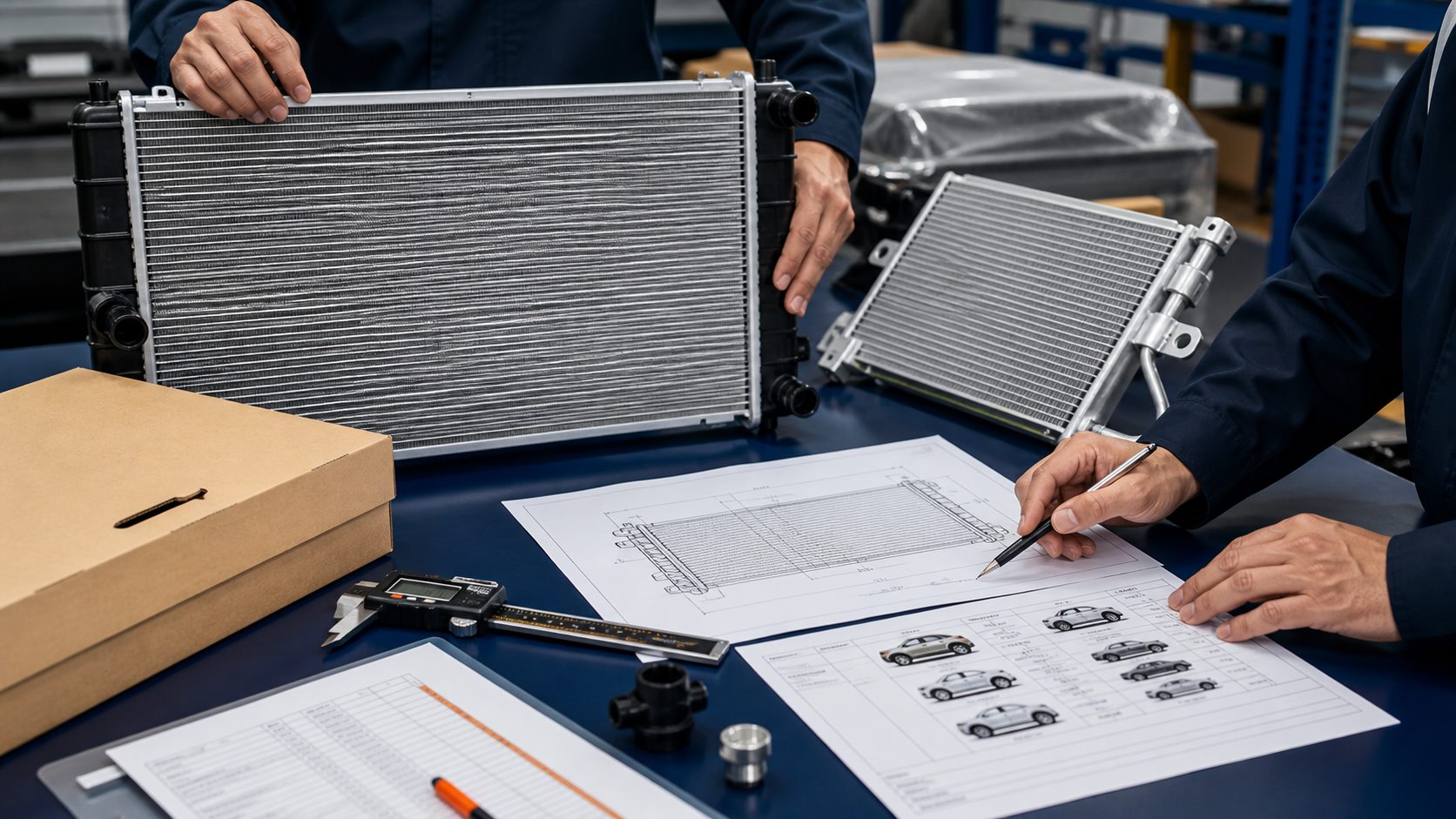
Verify reference and application
List the product family, complete OE number, alternates, customer item number, vehicle, chassis, engine, transmission where relevant, production period, and market. Do not merge references only because descriptions look similar.
When confidence is limited, request a drawing, dimensional report, photographs, or sample confirmation. Record unresolved points on the quotation or approval document.
Confirm the physical specification
Compare core and overall dimensions, tanks or manifolds, connections, fittings, mounts, sensor provisions, included accessories, and construction requirements. State the measurement method and drawing revision.
Product-specific points include radiator oil coolers, condenser receiver driers, evaporator connection blocks, and intercooler charge-air connections.
Review manufacturing evidence
Ask which controls apply to the actual product: incoming checks, dimensions, process parameters, brazing, leak testing, visual inspection, traceability, and packing inspection. Agree the reports and sampling level.
Certification should be supported by a current document with a relevant scope. It does not replace product approval, and one reference's report should not automatically cover another.
Agree packaging and trade conditions
Confirm unit protection, cartons, labels, barcodes, pallet requirements, destination rules, and handling needs. Separately confirm quantity, sample status, price basis, payment, lead time, Incoterm, shipping point, and documents.
Stock, price, delivery, testing, and included accessories can change by enquiry, so the current quotation and order confirmation should control.